


Why the future of websites may not have pages at all—and what mid-market companies should do about it now.
By Vincent Mazza, Managing Partner at eDesign Interactive.
For nearly thirty years, the architecture of the web has remained surprisingly stable. Every company website, whether for a B2B manufacturer or a global consumer brand, ultimately resolves to the same structure: a series of pages connected by links. Home page. About page. Product pages. Landing pages.
We rarely question this structure because it feels natural. But that familiarity hides an important truth: the “page” is not a digital invention at all. It’s a relic from paper.
When the internet emerged, designers needed a way to make digital information understandable. The closest metaphor available was the book. Books had pages, so websites did too. The early web essentially recreated printed information—only now those pages lived on screens instead of paper.
Over the past two decades, we’ve refined this architecture to extraordinary levels of sophistication. We built design systems, content management systems, component libraries, responsive layouts, and complex navigation flows. Entire industries formed around optimizing how pages are structured, searched, and converted.
Yet underneath all that innovation lies a deeper question: do people actually need pages?
Or do they simply need intuitive ways to find information?
That distinction may define the next era of digital experiences.
The Web Was Built for Pages. Humans Are Not.
If we look honestly at how people interact with digital information today, the “page” begins to look less like a necessity and more like a container from another era.
People rarely think in pages when they’re searching for answers. They think in intentions.
A visitor arriving at a website might be trying to solve a problem, compare products, understand a concept, or simply explore what a company offers. The page structure forces those intentions into predefined pathways—navigation menus, submenus, internal links.
But a user's intention rarely follows a neat hierarchy.
In the past, pages were simply the most efficient way we had to organize information online. They gave structure to content and allowed search engines to index it.
But that efficiency is now being challenged by a new technological shift: generative interfaces powered by artificial intelligence.
When Digital Products Become Generative
Artificial intelligence is beginning to change the very nature of digital interfaces.
Until recently, every digital product was designed as a fixed system. Designers created one interface intended to serve every possible user. That meant predicting user needs in advance and building pages that tried to accommodate them all.
AI introduces a different paradigm: generative digital products for an audience of one.
Instead of presenting a fixed interface, AI can dynamically generate experiences tailored to each user. Interfaces can be assembled, adapted, and reconfigured in real time based on what someone is asking for.
The implication is profound.
In a generative environment, there is no longer a single website experience for everyone. There is a unique experience for each person interacting with it.
Your website becomes your website for you, or as our Executive Director, Experience Strategy & Innovation, Kevin Cale, calls it, a living brand experience.
The screen may still resemble a familiar webpage—scrolling, tapping, interacting—but the interface behind those pixels is constantly changing. Content surfaces dynamically. Visual elements adapt to the conversation. The entire experience shifts based on intent.
Which raises a strange but fascinating question: if something looks like a website, behaves like a website, and responds like a website… does it actually need to be built as one?
The Coming Era of Conscious Interfaces
Imagine a digital experience that is less like a collection of pages and more like a responsive canvas.
A visitor lands on a brand’s digital presence and begins interacting with it. The surface might initially resemble a traditional website, but as the user engages, the interface transforms.
The same pixels that looked like a webpage might shift into a map when location becomes relevant. They might morph into an interactive diagram when explaining a concept. They could take the form of a video, a 3D environment, or a guided product exploration, depending on the context of the conversation.
The experience adapts continuously.
Instead of navigating pages, users interact with a system that understands what they’re trying to accomplish and assembles the right interface in real time.
We call this emerging paradigm intuitive experiences—interfaces built around user intent rather than page architecture.
Intelligent experiences are dynamic, agent-driven environments in which AI orchestrates information, visuals, and functionality based on a user's needs at that moment.
In this model, the “website” as we know it dissolves into something more fluid: an intelligent digital surface that adapts continuously to the person interacting with it.
It’s not science fiction. The building blocks already exist.
We’re still early in the timeline, but the trajectory is clear, and it’s accelerating.
The Bridge Between Today and Tomorrow
Despite the excitement around generative experiences, the reality for most businesses is straightforward: the traditional website isn’t going anywhere—at least not yet.
Search engines still rely on indexed content. Discovery still depends heavily on pages that can be crawled and ranked. For emerging and mid-market companies, visibility is critical. Without searchable content, it becomes far harder for potential customers to find you.
This creates an important divide.
Massive global brands with dominant market share might eventually experiment with radically different digital experiences. A company with the scale of Coca-Cola, for example, could theoretically launch a fully conversational or click-less interface without worrying about organic search traffic.
Most companies don’t have that luxury.
Mid-size B2B and B2C organizations still rely heavily on discoverability, search visibility, and structured content to grow their audience. Abandoning traditional web architecture prematurely would be risky.
But that doesn’t mean companies should ignore what’s coming.
Instead, the smartest strategy is to begin building bridges.
The "Crawl-Walk-Run" Path to Intentional Experiences
For most organizations, the path toward AI-driven digital experiences will unfold gradually rather than through a complete redesign.
Companies don’t need to replace their websites overnight. Instead, they can begin introducing intelligence into specific parts of the experience.
Search is often the most practical starting point.
Traditional website search is usually little more than a keyword lookup system. It returns lists of links and expects the user to refine queries until they stumble onto the right content.
AI can transform this dramatically.
Conversational search experiences allow users to ask questions naturally and receive contextual responses instead of simple link lists. These systems can interpret intent, summarize relevant content, and guide users toward solutions far faster than traditional navigation structures.
We recently saw this dynamic play out in a conversation with a client exploring how to upgrade their higher education website’s search capabilities using modern AI technologies. The question wasn’t simply whether an AI model could power the search function—it was how to structure the experience so that AI enhances the site rather than complicating it.
The answer lies in purpose-built frameworks designed to properly index site content and layer intelligent summarization on top of it. When implemented well, the result begins to resemble a conversational assistant embedded within the website itself.
Instead of typing keywords and browsing dozens of results, users can ask questions in natural language and receive relevant guidance immediately.
It’s not a radical transformation of the website—but it’s a powerful step toward intent-driven interaction.
Intent Already Exists in Today’s Best Digital Experiences
We can already see early examples of intent-driven design emerging in major digital platforms.
In hospitality, conversational search experiences are beginning to replace traditional property browsing. Instead of selecting filters and scrolling through endless results, travelers can describe their ideal vacation in plain language—perhaps a family trip near a beach, within a certain budget, during a specific season—and the system returns relevant options almost instantly.
The interface behaves more like a travel advisor than a catalog.
Retail brands are experimenting with similar models. Instead of forcing customers to navigate through product categories, conversational assistants can guide them toward the right items by asking clarifying questions and interpreting intent.
In both cases, the experience still includes familiar website elements. But the pathway to those elements is guided by intelligence rather than static navigation.
It’s a subtle but significant shift.
Why Exploration Still Matters
While intent-driven experiences promise incredible efficiency, there is also a risk in pushing too far in one direction.
Not every website visitor arrives with a clear goal.
Some people are browsing. They’re exploring products, ideas, or inspiration without a defined destination. Think of walking through a bookstore or wandering the aisles of a grocery store. Discovery often happens when we aren’t looking for something specific.
If every digital experience becomes hyper-transactional—focused entirely on detecting intent and delivering solutions—we risk eliminating that sense of exploration.
Good digital design must balance both behaviors.
Users should be able to browse freely when they want to explore. They should also be able to ask for help when they want efficiency.
Intelligent assistants should remain optional, helpful companions rather than intrusive salespeople interrupting the experience.
The best digital environments will support multiple paths simultaneously: navigation, search, exploration, and conversational guidance.
Intentional experiences are not about replacing browsing. They are about expanding how users interact with digital information.
A New Mindset for Digital Leaders
For digital leaders, product teams, and marketing organizations, the real challenge isn’t simply adopting AI tools. It’s rethinking how digital experiences are conceptualized.
For two decades, the web trained us to think inside rigid structures: pages, templates, modules, and navigation trees. Every experience had to be engineered within those constraints.
Generative technology allows us to think beyond them.
The digital products of the future will not simply be faster or more personalized versions of today’s websites. They will be fundamentally different kinds of experiences—adaptive, conversational, and continuously evolving.
This shift will not happen overnight.
But it will happen faster than many expect.
What Mid-Market Companies Should Do Now
For organizations trying to balance innovation with practical business needs, the goal should not be chasing every new AI trend.
Instead, the focus should be on thoughtful experimentation.
Start by identifying moments within your digital experience where users struggle to find information quickly. Search, product discovery, and support interactions are often the most obvious candidates.
Introduce intelligent tools in targeted ways that improve those moments without disrupting the broader website structure.
Test conversational interfaces, AI-assisted search, and dynamic content delivery in small, controlled implementations. Measure how users interact with them. Learn what improves engagement and what creates friction.
This incremental approach allows companies to evolve their digital experiences while maintaining the discoverability and stability that traditional websites still provide.
In other words: build today’s website while preparing for tomorrow’s interface.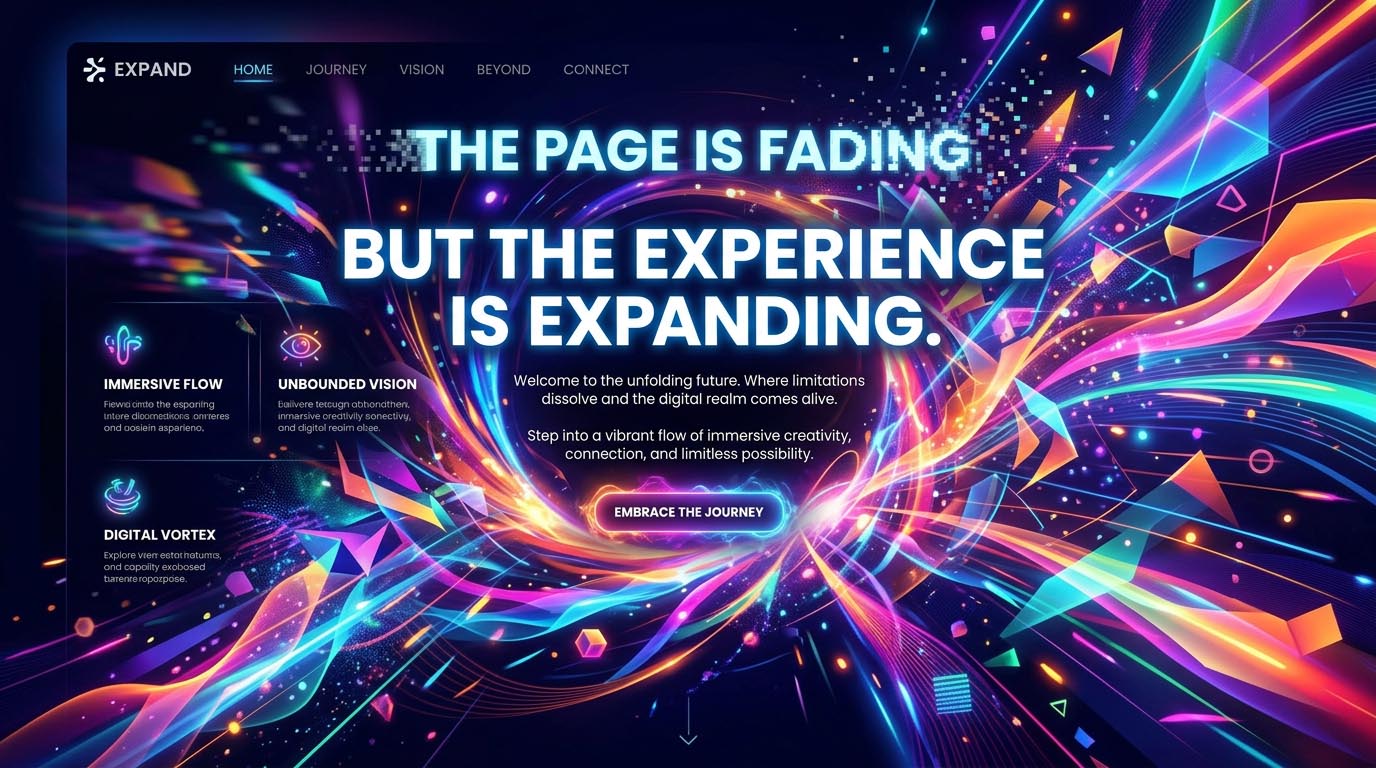
The Page Is Fading, But the Experience Is Expanding
Pages were never the true purpose of the internet. They were simply the most practical way to deliver information at the time.
As AI transforms how digital products are built and experienced, that architecture may gradually dissolve into something more fluid.
Instead of navigating pages, users will interact with systems that understand their intent and generate the right experience in real time.
The result will not feel like browsing a website at all.
It will feel like interacting with intelligence.
For companies willing to explore this shift thoughtfully—balancing today’s needs with tomorrow’s possibilities—the opportunity is enormous.
Because the next generation of digital experiences won’t simply be better websites.
There will be something entirely new.
Ready to design the future of your brand? Our team of web experts in New Jersey would love to hear about your vision and explore ideas together. Let’s connect.